DOL proposes H-1B and PERM wage increases: what’s changing?

Employers sponsoring foreign workers could face higher salary requirements under a Department of Labor proposal affecting H-1B, H-1B1, E-3, and PERM employment-based green cards. The DOL argues that current wage floors understate the pay of comparable U.S. workers and allow employers to undercut wages for Americans. Higher floors will favor more highly skilled, better-paid workers. This is a proposed agency policy change under existing immigration law, not new legislation or a change to substantive requirements.

The proposal raises all four wage levels. A final-rule package entered White House regulatory review on November 6, 2026. As of November 16, the published proposal remains the basis for this discussion, not an effective new wage schedule.

What is a prevailing wage determination?

A prevailing wage is a benchmark for comparable work in a particular geographic area, intended to protect U.S. workers against wage undercutting. Most employer-sponsored EB-2 and EB-3 green card cases require a formal DOL prevailing wage determination, or PWD, before filing PERM labor certification. It establishes the minimum salary for the permanent job offer.

For H-1B, H-1B1, and E-3 employment, employers generally must pay the higher of the prevailing wage or their actual wage for similarly qualified employees performing comparable work. A formal DOL-issued PWD is optional for these programs; qualifying wage sources can support the Labor Condition Application, or LCA. The DOL explains these requirements here. These work visa and immigration petitions by employers filed with USCIS (or directly with U.S. consulates and embassies, in some cases) rely on compliance with DOL regulations and procedures.

How would the prevailing wage calculation change?

The DOL’s Occupational Employment and Wage Statistics methodology uses occupation, location, and job requirements. Education, experience, special skills, and supervision influence the wage level. Current endpoints use averages within portions of the surveyed wage distribution; intermediate levels fall between them. The DOL proposal describes these approximate percentile benchmarks:

Approximate wage percentiles under the current and proposed systems
Wage levelCurrentProposed
I17th34th
II34th52nd
III50th70th
IV67th88th

These are positions in a wage distribution, not percentage raises. Moving from the 17th to the 34th percentile does not double the salary. Qualifying alternative wage surveys would remain available under the proposal.

What would this mean for employers?

Consider Software Developers, SOC 15-1252. The BLS May 2025 national dataset reports annual wages of $82,460 at the 10th percentile, $105,210 at the 25th, and $135,980 at the median.

Estimating between those published points produces approximately $93,100 at the 17th percentile and $116,300 at the 34th, a difference of about $23,200 annually, or 25%. This illustrates how a Level I benchmark could rise. DOL similarly uses linear interpolation in its economic analysis.

(This is merely an illustration, not an official PWD quote. National percentile estimates do not reproduce DOL’s current calculation exactly. Actual requirements depend on local data, job requirements, the applicable wage year, and the final rule.)

Higher floors could affect hiring budgets, retention, internal salary comparisons, and the affordability of permanent job offers. The higher-paid the occupational category, the greater the likely increase pursuant to actual wage distributions according to federal labor statistics. Employers already paying above the new required wage might need no increase. The proposed new rule maintains employers’ ability to seek an alternative wage survey in case government data does not accurately reflect the compensation for a specific industry or occupational category.

Would existing employees face higher wages at renewal?

The proposal would not reopen approved PWDs, LCAs, or permanent labor certifications. Its implementation section, however, covers pending and new PWD requests and certain new LCAs filed after the effective date. An H-1B extension needing a new LCA could therefore encounter higher wages.

Another section of the proposal says the changes would not apply to “renewals.” We are awaiting the final rule to see how that statement will operate. The proposal does not clearly establish what qualifies for a renewal exemption or reconcile it with the filing-date provisions. Employers should not assume that a same-employer extension, an employer change, or a previously sponsored worker automatically preserves an old wage. An approved PWD also has a validity period, not indefinite protection. See the proposal’s discussion of implementation and alternatives for small employers.

Can remote work provide flexibility?

DOL considered, but rejected, a national wage standard for remote work, citing statutory language requiring wages tied to the area of intended employment. Geographic differences therefore remain relevant.

For H-1B employment, the employee’s actual work location generally controls, including a home office. DOL cautions against artificial worksite designations. Genuine remote work in a lower-cost area may affect the wage, but headquarters cannot simply replace the actual worksite.

PERM has separate headquarters guidance for unanticipated worksites, relevant to qualifying roving and remote arrangements. Where applicable, the PERM wage can remain tied to headquarters while the employee lives elsewhere, potentially in a lower-cost area. That possibility requires review of the actual arrangement. Employers must disclose remote-work flexibility and geographic restrictions consistently; DOL decisions illustrate the consequences of omitting that flexibility from recruitment.

What about other immigration options?

TN, O-1, L-1, and E-1/E-2 visa categories do not rely on DOL prevailing wage calculations. EB-1 petitions and EB-2 national interest waivers do not rely on PERM labor certifications.

H-2B does require a PWD, but follows a separate wage framework not addressed in this proposal. H-2A agricultural employment also has separate rules. Other wage and employment obligations still apply.

Schedule A cases, including eligible nurses and physical therapists, still use PWDs under Section 656.40. Bypassing ordinary PERM recruitment does not exempt those determinations from the proposed methodology.

When could the new prevailing wage floors take effect?

OIRA review generally has a 90-day limit, but can finish sooner or be extended. A major final rule generally requires at least 60 days after publication or congressional receipt, whichever is later, subject to statutory exceptions.

Early 2027 is a plausible start date for implementation of the new proposed rule. Review concluding in December through February, followed promptly by publication and congressional receipt, suggests implementation around February through April. It may already be in effect for the FY 2028 H-1B lottery in March 2027. Fast-tracked review, extensions, transition provisions, or litigation may change this timeline.

Moro Legal LLC helps employers plan H-1B sponsorship and employment-based green card cases around changing requirements.

Applying for U.S. Citizenship: New Rules, Greater Scrutiny

Applying for U.S. citizenship is becoming more complicated. Naturalization denial rates more than doubled year over year, from 8.8% in the quarter ending June 2025 to 18.2% in the quarter ending June 2026, according to the latest official USCIS quarterly data. That increase comes amid greater scrutiny of naturalization applications and new policies on neighborhood investigations, financial responsibilities, and what constitutes “good moral character” for applicants.

The statistics do not establish that the new policies alone caused the increase. The newest USCIS memorandum, issued on November 4, 2026, is too recent for its effects to be known yet. The August 2026 neighborhood-investigation guidance was also published after the June 2026 reporting period, although USCIS had already re-established neighborhood investigations as part of naturalization background checks in 2025.

For those applying for naturalization, responding to a request for evidence, or reviewing a naturalization denial, the practical message is to prepare a substantial record with evidence of eligibility and good moral character.

What changed in the USCIS naturalization policies?

Three recent USCIS policy documents deserve close attention:

  • August 15, 2025: The good moral character memorandum directs officers to evaluate positive attributes and contributions, as well as misconduct, under a holistic approach.
  • August 25, 2026: The naturalization investigations policy alert explains neighborhood investigations and the evidence USCIS may consider when deciding whether to conduct or waive one.
  • November 4, 2026: The public benefits and financial support memorandum addresses dependent support, unlawfully obtained benefits, sponsorship obligations, and intentional avoidance of self-sufficiency. It also calls for further implementation guidance and changes to Form N-400.

USCIS neighborhood investigations: What should applicants expect?

Under the USCIS Policy Manual, officers may investigate an applicant’s residence, conduct, reputation, and community connections. This can include speaking with neighbors, landlords, employers, coworkers, or other people who presumably know the applicant.

Investigations generally occur before the naturalization interview, but USCIS may conduct one later, before the oath ceremony. Officers decide whether to conduct or waive an investigation based on the circumstances. Not every applicant will receive a neighborhood visit.

USCIS officers conducting witness interviews should identify themselves and explain the nature of the inquiry while protecting confidential information. If USCIS intends to rely on adverse information unknown to the applicant, policies generally require giving an opportunity to the applicant to respond before denial.

What should character reference letters include?

USCIS policy now recommends at least two letters from people familiar with the applicant, preferably U.S. citizens who are not relatives. The letters are optional, and in fact the official form instructions from USCIS do not mention this policy recommendation. However, failing to submit such letters does not mean the applicant will be found to lack good moral character.

Letters of support for naturalization should be signed and dated and include:

  • The writer’s name, contact information, and immigration or citizenship status, with supporting status documentation as contemplated by USCIS guidance.
  • How the writer knows the applicant and how long they have known each other.
  • Specific, firsthand examples of honesty, reliability, family responsibilities, work, or community involvement.
  • The writer’s assessment of the applicant’s moral character and attitude toward the principles of the U.S. Constitution.

Concrete examples are more helpful than a generic statement that someone is a good person. Residence records, employment documentation, tax records, and evidence of family support or caregiving may also help USCIS evaluate the application and whether an investigation is necessary. Letters do not guarantee that USCIS will waive an investigation.

Good moral character requires more than a clean criminal record

Good moral character has long been a naturalization requirement. The August 2025 memorandum places renewed emphasis on affirmative evidence of positive conduct, rather than treating the absence of criminal problems as the entire inquiry.

Relevant evidence may include lawful employment, compliance with tax obligations, education, family caregiving, community service, financial responsibility, and rehabilitation after past misconduct. This does not make a college degree, volunteer work, or a particular income a universal requirement for citizenship. Applicants should explain their actual circumstances, including disability, retirement, unemployment, or unpaid caregiving.

The USCIS Policy Manual’s good moral character framework remains important. Favorable evidence does not automatically overcome a statutory bar, and naturalization eligibility is governed by law.

Two decisions cited in the policy materials illustrate the distinction:

Can public benefits affect a citizenship application?

Lawfully receiving public benefits does not automatically disqualify someone from naturalization. The November 2026 memorandum instead focuses on particular conduct, including fraud, willful failure to support dependents, failure to meet sponsorship obligations, and intentional avoidance of self-sufficiency.

Means-tested programs generally base eligibility on income or resources. Examples include Supplemental Security Income (SSI), SNAP food assistance, TANF, Medicaid, and certain housing assistance. Eligibility rules differ by program. This is not an exhaustive list, and the memorandum’s concern about unlawfully obtaining benefits is not limited to means-tested programs. Naturalization good moral character review should not be confused with the separate public charge rules.

Willful failure to support dependents

Willful failure or refusal to support dependents can prevent a finding of good moral character unless extenuating circumstances apply. A court support order is not always necessary, and the inquiry can extend beyond minor children or dependents living in the United States.

Inability to pay is different from deliberately refusing to pay. Evidence of unemployment, disability, actual financial circumstances, payments made, and good-faith efforts may matter under 8 C.F.R. § 316.10 and the USCIS Policy Manual’s discussion of conditional bars.

In Dos Reis v. McCleary, 200 F. Supp. 3d 291 (D. Mass. 2016), the court upheld a naturalization denial involving willful failure to support children and false testimony. The decision underscores the importance of financial records and truthful explanations.

Unlawfully obtaining benefits or helping dependents obtain them

Misrepresenting income, household members, identity, or other eligibility facts can create serious problems. The memorandum also addresses helping dependents unlawfully obtain benefits. An innocent mistake or overpayment is not automatically fraud, but applicants should retain notices, explanations, repayment records, and any agency findings.

The memorandum cites Matter of Pinzon, 26 I&N Dec. 189 (BIA 2013), concerning a false-statement offense involving fraud. That case involved passport-related misrepresentations, not public benefits, but illustrates why fraudulent conduct can carry immigration consequences.

I-864 sponsorship obligations and address changes

Signing Form I-864 or I-864EZ creates enforceable support obligations. A household member who signs Form I-864A may also assume contractual obligations. Applicants who have sponsored someone should review whether they have complied with the applicable commitments. A sponsored immigrant’s receipt of benefits does not, by itself, establish that the sponsor violated those obligations.

Another legal obligation triggered by signing the I-864 is that sponsors must notify USCIS of an address change by filing Form I-865, Sponsor’s Notice of Change of Address, within 30 days of moving, while the sponsorship obligation remains in effect. The rule applies to joint and substitute sponsors as well. See 8 C.F.R. § 213a.3. A noncitizen sponsor may have a separate obligation to report their own address change via Form AR-11 or the USCIS website.

The memorandum also discusses commitments made through Forms I-134 and I-134A. Those forms do not create the same statutory support obligation as Form I-864, a distinction the memorandum acknowledges.

Intentional avoidance of self-sufficiency

The new memorandum directs officers to consider whether someone intentionally avoided self-sufficiency to obtain means-tested benefits, such as deliberately reducing work for that purpose. It calls for an individualized analysis. Medical conditions, caregiving responsibilities, and other legitimate personal circumstances should be documented and distinguished from intentional avoidance.

What if you receive an N-400 RFE or a naturalization denial?

A request for evidence (sometimes labeled a “notice of continuance” for naturalization applicants) should be answered with records that address the specific concern, not simply more general character letters. Review the notice carefully, identify the applicable deadline, and provide a clear explanation supported by documents.

If USCIS denies the application, promptly review the decision and whether a Form N-336 request for a hearing, or a new N-400 application altogether, may be appropriate. Filing deadlines are short. Reapplying without addressing the reason for denial may lead to the same result.

Moro Legal, LLC, assists with naturalization applications, evidence requests, and review of denied N-400 applications. Contact our office to discuss your circumstances and the evidence your case may require.

USCIS naturalization data

The introductory comparison uses the USCIS N-400 performance data for fiscal year 2025, third quarter and the corresponding fiscal year 2026, third-quarter data. Additional reports are available through the USCIS immigration and citizenship data page.

The denial rate is denials divided by approvals plus denials, including military and nonmilitary cases, for each quarter ending June 30. It is not a June-only rate, a percentage of new filings, or a prediction of any individual applicant’s outcome.

USCIS Filing Deadlines: Weekend Extensions, Online Filing, and the UTC Time Trap

A USCIS deadline falling on a weekend does not always move to Monday. Under guidance effective October 23, 2026, the answer depends on the type of deadline and whether you submit on paper or electronically.

What changed, and what stayed the same?

USCIS’s September 23, 2026 policy alert reverses part of its March 2023 guidance. The earlier policy extended certain eligibility-based deadlines, including birthday-related cutoffs, when they fell on a weekend or federal holiday. The revised policy applies to paper filings received on or after October 23, 2026.

  • Paper deadlines measured in days: The “next business day” rule remains effective. Weekends and holidays count toward the period, but if a deadline falls on a Saturday, Sunday, or federal holiday, an otherwise qualifying paper filing may arrive by the end of the next business day.
  • Eligibility-based deadlines: The extension no longer applies merely because the deadline falls on a weekend or holiday. For example, USCIS says a special immigrant juvenile petition requiring filing before age 21 cannot wait until Monday because the applicant’s 21st birthday falls on Sunday.

The underlying regulation is 8 CFR § 1.2. A deadline printed as a calendar date may still originate from a period measured in days, so it is important to confirm the governing rule and not just the date listed.

Online filings do not receive the weekend extension

Do not assume you can submit electronically on Monday when your deadline falls on Sunday. USCIS’s Policy Manual, Chapter 6, Section E expressly states that electronically-submitted benefit requests do not receive this extension allowed for paper-filed cases, given the electronic submissions are received immediately.

For online submission of an evidence response to Requests for Evidence (RFEs) or Notices of Intent to Deny (NOIDs), follow the notice and account instructions and complete submission by the applicable electronic deadline. After uploading all relevant documents, submission is a separate required step that will be confirmed by an update on the USCIS case status after the evidence has been transmitted.

The UTC time trap: your filing day may end before dinner

USCIS’s H-1B electronic filing FAQ confirms that online Form I-129 receipt dates use Coordinated Universal Time (UTC), not the filer’s local time. DHS’s online I-765 guidance likewise identifies UTC.

Where a deadline runs through 11:59 p.m. UTC, that corresponds to 5:59 p.m. in Denver during daylight saving time, or 4:59 p.m. during standard time, on the same date. Filing later that evening can produce the following day’s receipt date – if filing on the evening of the deadline, you may see a status indicating that the response was not received before the deadline even 8 hours before midnight.

Whenever electronically submitting a response to a USCIS request for evidence, submit as early as possible and save confirmation records.

Paper responses: delivery method matters

For a paper RFE or other evidence response, follow the notice’s delivery instructions. Do not assume you or a privately arranged individual courier can hand-deliver it to a USCIS office. Ordinary submissions must use USPS or a USCIS-approved commercial courier, absent specific authorization otherwise.

Chapter 6, Section A and footnote 2 name UPS, FedEx, and DHL, while allowing other USCIS-approved carriers. An unapproved service risks refused delivery and non-acceptance. USCIS’s lockbox instructions are narrower: USPS, FedEx, DHL, or UPS only.

Use the correct address for your carrier and allow a delivery buffer. Mailing a response by the deadline generally does not establish timely receipt.

Given the USCIS announcement on August 10, 2026, of a new initiative to require electronic filing of forms, it is critical for anyone working with USCIS to be familiar with the rules of the electronic filing system.

Exceptions: asylum and refugee procedures

The USCIS Policy Manual footnotes identify distinct limitations:

  • Asylum applications: Footnote 42 identifies separate rules for evidence requests, notices of intent to deny, denials, and terminations which are governed by asylum procedure.
  • Form I-590 refugee registration: Footnotes 3 and 36 exclude it from ordinary submission procedures. It is prepared through the overseas Resettlement Support Center process and deemed filed at the refugee interview when signed.
  • Other controlling provisions: Specific statutes or regulations can supersede the general definition of “day.”

(These are different exceptions and not universal for every asylum or refugee-related case. Confirm the regulations governing your particular submission.)

Facing a filing or response deadline? Schedule a consultation with Moro Legal before relying on an extension or last-minute delivery.

O teste de cidadania dos EUA acabou de ficar ainda mais difícil. Você consegue responder às novas perguntas?

estudando pelo novo teste da cidadania dos Estados UnidosApenas 1 em cada 3 cidadãos dos EUA conseguiu passar no teste de cidadania dos EUA em uma pesquisa nacional de 2018. Esse teste acabou de ficar ainda mais difícil. A partir de 1º de dezembro de 2020, os candidatos à cidadania dos EUA agora enfrentam um exame cívico revisado com novas questões que abrangem a história dos EUA e educação cívica. Os candidatos devem agora responder duas vezes mais perguntas corretamente para serem aprovados.

O teste de cidadania ou naturalização dos EUA consiste em duas partes: a língua inglesa e a educação cívica dos EUA. A parte da língua inglesa testa a capacidade dos candidatos de falar, ler e escrever na língua inglesa. Os oficiais avaliam a capacidade dos candidatos de falar e entender inglês por meio da entrevista de naturalização. A parte de leitura e escrita consiste em escrever e ler uma frase curta, como “George Washington foi o primeiro presidente dos Estados Unidos”.

Perguntas do teste de cidadania dos EUA

21 das questões novas e revisadas adicionadas pelo USCIS à edição 2020 do teste de cidadania cívica dos EUA estão incluídas no questionário abaixo. Teste seus conhecimentos sobre a cidadania americana e veja se você consegue responder a todas as perguntas. As possíveis respostas consideradas corretas pelo USCIS também estão incluídas. Mas lembre-se, as perguntas no teste de naturalização estarão em inglês para quem não tiver uma isenção especial.


Este questionário contém Perguntas do Teste da Cidadania dos EUA.
Clique em "Próximo" para começar!


Mudanças no Teste de Cidadania

Há um total de 128 questões possíveis que podem ser feitas no novo teste de naturalização. Muitas das perguntas do teste de civismo anterior foram reescritas e suas respostas mudaram. Além disso, foram adicionadas 28 novas perguntas que abrangem detalhes adicionais sobre a história dos EUA e o sistema político americano. No teste antigo, os candidatos podiam responder a um total de 10 perguntas e, para passarem no teste, eles precisariam responder 6 delas corretamente.

Agora, os oficiais farão um total de 20 perguntas aos candidatos. Os candidatos terão que responder 12 das 20 questões corretamente, para passar no teste.

O teste é oral e os candidatos devem responder com a resposta correta da memória.

Anteriormente, o oficial de imigração parava de fazer perguntas quando um candidato respondesse corretamente o suficiente para obter uma pontuação de aprovação. Agora, os candidatos responderão ao total de 20 perguntas, mesmo que já tenham respondido ao número necessário de perguntas para passar no teste.

Isenções e considerações especiais

Por enquanto, o USCIS anunciou que “manterá suas diretrizes atuais para considerações especiais particulares estatutariamente para candidatos que tenham 65 anos ou mais e tenham pelo menos 20 anos de status de residente permanente legal ”.

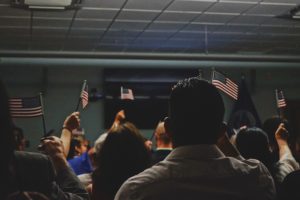
Cerimônia de naturalização norte-americanaOs candidatos com 65 anos ou mais e com green card por pelo menos 20 anos, responderão a 10 perguntas no total de uma lista menor. Eles devem responder 6 corretamente para passar.
As novas questões cívicas se aplicam a todos os participantes do exame de cidadania, exceto aqueles na categoria de consideração especial, independentemente da idade.

Alguns podem se qualificar para uma Exceção de Deficiência Médica, que pode isentar os candidatos de fazer o teste cívico. O site do USCIS lista as qualificações para isenção dos requisitos de língua inglesa e civismo.

Como se preparar para o novo teste de cidadania

A versão 2020 do teste cívico só se aplicará aos candidatos de naturalização com uma data de depósito (data de recebimento) em ou após 1º de dezembro de 2020. Os candidatos à cidadania dos EUA que enviaram suas inscrições antes de 1º de dezembro de 2020 ainda receberão a versão 2008 do teste.

O USCIS publicou guias de estudo, cartões de memória e todas as perguntas e respostas do novo teste de cidadania dos EUA no site do USCIS gratuitamente.

The U.S. citizenship test just got harder. Can you answer the new questions?

Studying for the New U.S. Citizenship ExamOnly 1 in 3 U.S. citizens were able to pass the U.S. citizenship test in a 2018 national survey. That test just got much harder. Beginning December 1, 2020, applicants for U.S. citizenship now face a revised civics exam with new questions covering U.S. history and civics. Applicants must now answer twice as many questions correctly to pass.

The U.S. citizenship or naturalization test consists of two parts: the English language and U.S. civics. The English portion tests applicants’ ability to speak, read and write in the English language. Officers evaluate applicants’ ability to speak and understand English through the naturalization interview. The reading and writing portion consist of writing and reading a short sentence, such as “George Washington was the first President of the United States.”

U.S. Citizenship Test Questions

21 of the new and revised questions added by USCIS to the 2020 edition of the U.S. citizenship civics test are included in the quiz below. Test your knowledge about U.S. civics and see if you can answer every question. The possible responses deemed correct by USCIS are also included.


This quiz reviews the new U.S. Citizenship Test Questions.
Click "Next" to begin!


Changes to the Citizenship Test

There are a total of 128 potential questions that may be asked on the new naturalization test. Many of the questions on the prior civics test have been rewritten and their answers have changed. In addition, 28 new questions have been added that cover additional details about U.S. history and the American political system. On the old test, applicants could be asked up to a total of 10 questions, and to pass, they would need to answer 6 of them correctly.

Now, applicants will be asked 20 questions total. Applicants will have to answer 12 out of 20 questions correctly, in order to pass.

The test is oral, and applicants must respond with the correct answer from memory.

Previously, the immigration officer would stop asking questions once an applicant answered enough correctly to achieve a passing score. Now, applicants will be asked the full 20 questions even if they have already answered the required number of questions to pass the test.

Exemptions and Special Considerations

For now, USCIS has announced that “will maintain its current guidelines for statutorily established special considerations for applicants who are 65 years old or older and have at least 20 years of lawful permanent resident status.”

Becoming a U.S. CitizenApplicants age 65 or older, and have held green cards for at least 20 years, will be asked 10 questions in total from a shorter list. They must answer 6 correctly to pass.

The new civics questions will apply to all citizenship exam-takers besides those in the Special Consideration category regardless of age.

Some individuals may qualify for a Medical Disability Exception, which can exempt applicants from having to take the civics test altogether. The USCIS website outlines the qualifications for exemption from the English language and civics requirements.

How to Prepare for the New Citizenship Test

The 2020  version of the civics test will only apply to those naturalization applicants with a filing date (received date) on or after December 1st of 2020. U.S. citizenship applicants who filed their applications before December 1st, 2020, will still be administered the 2008 version of the test.

USCIS has published study guides, flash cards, and all questions and answers to the new U.S. citizenship test on the USCIS website for free.

* * *

Adiando o seu caso de imigração? Veja por que você deve agir agora.

Razão # 1: O USCIS Aumentará Em Breve As Taxas De Inscrição

Moro Legal, LLC - Immigration Law Office of Joseph Alain MoroO USCIS anunciou em 31 de julho de 2020, um ajuste de taxas para determinados formulários de solicitação de imigração e naturalização para ajudar a atender às suas necessidades  operacionais. Que um aumento de taxas estava chegando não é novidade . Em 15 de maio de 2020, o USCIS informou ao Congresso que a agência estava enfrentando um déficit orçamentário e estava solicitando US $ 1,2 bilhão em financiamento para permanecer aberta. Naquela época, o USCIS solicitou a aprovação de uma sobretaxa adicional de 10% em todas as taxas de inscrição do USCIS para financiar suas operações.

A má notícia é que os aumentos de taxas há muito esperados do USCIS estão finalmente chegando.

A boa notícia é que, se você estava adiando seu green card, cidadania ou outro caso relacionado à imigração, ainda tem um pouco de tempo para se inscrever antes que o aumento da taxa entre em vigor.

Quando o aumento das taxas entrará em vigor?

A regra final que aumenta algumas taxas de inscrição deverá entrar em vigor em 2 de outubro de 2020. Isso significa que os pedidos recebidos pelo USCIS antes de 1º de outubro de 2020 podem evitar as novas sobretaxas e pagar a taxa antiga, na maioria dos casos muito mais baixa.


Quem será afetado?

USCIS increasing immigration and citizenship processing feesAs pessoas solicitando a cidadania americana terão o maior aumento de taxas, com taxas saltando de US $ 640 para US $ 1.170.

Provavelmente, a maior mudança que afeta as pessoas que solicitam ajuste de status ou green cards para pessoas que já estão nos Estados Unidos é que o USCIS não renunciará mais às taxas do Formulário I-765, Pedido de Autorização de Emprego e Formulário I-131 , Pedido de documento de viagem, para pedidos de ajuste de status. Muitos candidatos enviam esses formulários juntamente com os pedidos de ajuste para solicitar uma autorização de trabalho e um documento de viagem enquanto o pedido de green card estiver pendente. A partir de 2 de outubro de 2020, os solicitantes de green card nos EUA terão que pagar US $ 1.140 adicionais em taxas para solicitar esses documentos, além do aumento de US $ 380 na taxa de ajuste de status.

Algumas taxas sofrerão uma ligeira queda após 2 de outubro, incluindo renovações de green cards (formulário I-90) e solicitações de certificados de cidadania (formulário N-600). No entanto, a grande maioria dos candidatos verá um aumento.


Quão ruins são os aumentos de taxas do USCIS?

Reunimos uma lista de alguns dos formulários que terão aumento de taxas após 2 de outubro de 2020:

Taxas de imigração do USCIS antes e depois de 2 de outubro de 2020

Formulário de imigração

Taxas antes de
2 de outubro de 2020

Taxas a partir de
2 de outubro de 2020

I-129 (para candidatos a visto de não-imigrante de ocupação especializada H1-B)

$ 460

$ 555

I-129 (para vistos E e TN)

$ 460

$ 695

I-129 (para classificações de vistos O)

$ 460

$ 705

I-129 (para vistos L, cessionários da empresa)

$ 460

$ 805

I-130 (Petição de parente estrangeiro, enviado por correio)

$ 535

$ 560

I-131 (Pedido de documento de viagem)

$ 575

$ 590

I-131A (Pedido de documento de viagem)

$ 575

$ 1.010

I-485 (Pedido para ajustar o status à residência permanente)

$ 750

$ 1.130

I-526 (Petição de Imigrante por Investidor Estrangeiro para candidato a Visto de Investidor Imigrante EB-5)

$ 3.675

$ 4.010

I-539 (Aplicativo para estender / alterar o status de não imigrante, online)

$ 370

$ 390

I-539 (Pedido de extensão / alteração do status de não imigrante, enviado por correio)

$ 370

$ 400

I-751 (Petição para remover condições de residência)

$ 595

$ 760

I-765 (Pedido de Autorização de Emprego, Não DACA)

$ 410

$ 550

N-400 (Pedido de Naturalização)

US $ 640 *

$ 1.170 **

* Taxas reduzidas atualmente disponíveis para solicitantes de naturalização / cidadania de baixa renda.
** Nenhuma taxa reduzida para solicitações de cidadania dos EUA estará disponível sob a nova tabela de taxas implementada em 2 de outubro de 2020.

As informações na tabela acima vêm da publicação do USCIS sobre a regra final no Federal Register. Você também pode verificar a regra final aqui para obter a lista completa.

Razão # 2: A Nova Regra De Encargo Público É Suspensa, Facilitando A Inscrição E A Aprovação De Mais Casos.

Sim, não apenas as taxas do USCIS estão aumentando – fazendo com que muitos candidatos se apressem para aplicar antes que as novas taxas entrem em vigor – mas a regra final de Inadmissibilidade por Motivos de Encargo Público foi suspensa enquanto houver uma emergência sanitária nacional declarada em resposta à pandemia de COVID-19. Isso se deve a uma decisão do Tribunal Distrital dos EUA no Distrito Sul de Nova York, em 29 de julho de 2020, mas se aplica ao ajuste de candidatos a status em todo o país.

O que significa a suspensão da nova regra de encargo público?

The clock is tickingEnquanto a ordem do tribunal estiver em vigor, as pessoas podem solicitar o ajuste do status e green cards sem precisar enviar as evidências adicionais exigidas pela nova regra de Encargo Público. Essa evidência inclui relatórios de crédito, 12 meses de extratos de conta bancária, documentação de imóveis e outros ativos – em muitos casos, centenas de páginas de evidências adicionais. A nova regra de Encargo Público exige que um Formulário I-944 adicional seja preenchido e enviado com a maioria dos pedidos de ajustes de status; esse requisito foi suspenso enquanto a decisão do tribunal e a emergência nacional do COVID-19 estiverem em vigor. Para obter mais informações sobre a nova regra de Encargo Público, consulte o relatório da Associação Americana de Advogados de Imigração, detalhando a regra final.

Neste momento, a injunção nacional é a lei suprema do país e a regra de Encargo Público que entrou em vigor em 24 de fevereiro de 2020 foi suspensa por enquanto. Tenha em mente de que injunções são apenas medidas temporárias que podem ser revertidas a qualquer momento. A lei de imigração é complexa e as regras podem mudar de um dia para o outro. Por isso, é importante consultar um advogado de imigração para saber o que fazer no seu caso. Monitore também o site do USCIS para obter atualizações.

Putting off your immigration case? Here’s why you need to act now.

Reason #1: USCIS Will Soon Increase Application Fees

Moro Legal, LLC - Immigration Law Office of Joseph Alain Moro USCIS announced on July 31, 2020, a fee adjustment for certain immigration and naturalization request forms to help meet its operational needs. That a fee increase was coming is nothing new. On May 15, 2020, USCIS informed Congress that the agency was facing a budget shortfall and was requesting $1.2 billion in funding to stay open. At that time, USCIS asked for approval of an additional 10% surcharge on all USCIS application fees in order to fund its operations.

The bad news is that the fee increases long expected from USCIS are finally arriving.

The good news is that if you were postponing your green card, citizenship or other immigration-related case, you still have a short time to apply before the fee increase goes into effect.

When will the increased fees go into effect?

The final rule which increases some application fees is expected to take effect on October 2, 2020. That means that applications received by USCIS on or before October 1, 2020 can avoid any fee surcharges and pay the old fee, in most cases much lower.

Who will be affected?

USCIS increasing immigration and citizenship processing feesPeople applying for U.S. citizenship will see the biggest fee increase, with fees jumping from $640 to $1,170.

Likely the biggest change to affect people applying for adjustment of status, or green cards for people already in the United States, is that USCIS will no longer waive the fees for the Form I-765, Application for Employment Authorization, and Form I-131, Application for Travel Document, for adjustment applications. Many applicants file these forms together with adjustment applications to request a work permit and a travel document while the green card application is pending. Starting October 2, 2020, green card applicants in the U.S. will have to pay an additional $1,140 in fees to request these documents, in addition to the $380 increase in the adjustment of status fee.

Some fees will see a slight decrease after October 2, including green card renewals (Form I-90) and applications for certificates of citizenship (Form N-600). However, the vast majority of applicants will see an increase.

How bad are the USCIS fee increases?

We have put together a list of some of the forms that will see increased fees after October 2, 2020:

USCIS Immigration Fees Before and After October 2, 2020

Immigration FormFee Before
Oct. 2, 2020
Fee Beginning
Oct. 2, 2020
I-129 (for H1-B Specialty Occupation Nonimmigrant Visa candidates)$460$555
I-129 (for E visas and TN visas)$460$695
I-129 (for O visa classifications)$460$705
I-129 (for L visas, Intracompany Transferees)$460$805
I-130 (Petition for Alien Relative, paper filing)$535$560
I-131 (Application for Travel Document)$575$590
I-131A (Application for Travel Document)$575$1,010
I-485 (Application to Adjust Status to Permanent Residence)$750$1,130
I-526 (Immigrant Petition by Alien Investor for EB-5 Immigrant Investor Visa candidates)$3,675$4,010
I-539 (Application to Extend/Change Nonimmigrant Status, online)$370$390
I-539 (Application to Extend/Change Nonimmigrant Status, paper filing)$370$400
I-751 (Petition to Remove Conditions on Residence)$595$760
I-765 (Application for Employment Authorization, Non-DACA)$410$550
N-400 (Application for Naturalization)$640*$1,170**

* Reduced fees currently available for low-income naturalization/citizenship applicants.
** No reduced fees for US citizenship applications will be available under the new fee schedule implemented October 2, 2020.

The information on the table above comes from USCIS’s publication on the final rule in the Federal Register. You can also check the final rule here for the complete list.

Reason #2: The new Public Charge rule is suspended, making applications easier and approval likely for more cases.
Yes, not only are USCIS fees increasing – making many applicants rush to apply before new fees go into effect – but the Inadmissibility on Public Charge Grounds Final Rule was suspended as long as there is a declared national health emergency in response to the COVID-19 outbreak. This is due to a decision on July 29, 2020, by the U.S. District Court for the Southern District of New York, but applies to adjustment of status applicants nationwide.

What does the suspension of the new Public Charge rule mean?

The clock is tickingAs long as the court’s order is in effect, people can apply for adjustment of status and green cards without having to submit the additional evidence that was required under the new Public Charge rule. This evidence includes credit reports, 12 months of bank account statements, documentation of real estate and other assets – in many cases, hundreds of pages of additional evidence. The new Public Charge rule requires an additional Form I-944 be completed and submitted with most adjustment of status applications; this requirement has been suspended while the court decision and the COVID-19 national emergency are in effect. For further information about the new Public Charge rule, see the American Immigration Lawyers Association report detailing the final rule.

At this moment, the nationwide injunction is the law of the land and the public charge rule that went into effect on February 24, 2020, has been suspended for the time being. Be advised that injunctions are only temporary measures that can be reversed at any time. Immigration law is complex and the rules can change from day to day, so it is important to consult an immigration lawyer to know what to do in your case. Also monitor USCIS’s website for updates.

EUA revogam vistos de estudante se escolas mudarem cursos presenciais para aulas on-line

EUA revogam vistos de estudante se escolas mudarem cursos presenciais para aulas on-line

O governo norte-americano anunciou em 14 de julho a revogação dessa proposta política. Fiquem atentos para novas atualizações.

Em 6 de julho de 2020, o Programa de Estudantes e Visitantes de Intercâmbio (SEVP) anunciou uma alteração na sua permissão temporária para estudantes estrangeiros nos EUA que estão participando de suas aulas on-line durante o semestre do outono de 2020 devido a pandemia de coronavírus.

Uma regra final temporária será publicada no Registro Federal do Departamento de Segurança Interna dos EUA. Existem mais de um milhão de estudantes internacionais nos EUA que podem ser afetados por essas mudanças.

Durante os semestres da primavera e verão de 2020, o SEVP permitiu que os portadores de visto de estudantes fizessem mais cursos on-line do que normalmente são permitidos para manter o status de visto válido por causa da pandemia do COVID-19. No entanto, essa política está mudando para o semestre do outono.

Os estudantes nos EUA no semestre de outono de 2020 com vistos F-1 ou M-1 não podem fazer uma carga completa do curso on-line e permanecer no país.

Alunos ativos que estão nos Estados Unidos e matriculados em programas que mudarem para cursos totalmente on-line “devem sair do país ou tomar outras medidas, como transferir para uma escola com instruções presenciais” para manter o status legal. Se não o fizerem, estarão violando o status do visto. Eles podem ser submetidos a procedimentos de remoção para deportação.

São permitidas aulas presenciais normais, e os alunos podem frequentar no máximo uma aula (ou três horas de crédito) on-line e ainda estar em situação legal.

Os portadores de visto de estudante em escolas que adotaram aulas “híbridas” que são on-line e presenciais, podem fazer mais uma aula on-line. Esta opção não está disponível para estudantes F-1 em programas de treinamento em inglês ou para estudantes de nível profissional M-1, que são impedidos de participar de qualquer curso online.

Advogado de imigração Joseph Alain Moro - EUA revogam vistos de estudante se escolas mudarem cursos presenciais para aulas on-line

No entanto, em qualquer caso , a escola deve fornecer o Formulário I-20 para o SEVP que ateste que o programa do aluno não está totalmente online, que a carga horária do aluno não está totalmente online no semestre e que o aluno está recebendo o número mínimo de aulas on-line, para o progresso normal no programa de graduação .

As escolas, faculdades e universidades serão obrigadas a notificar o Departamento de Segurança Interna dos EUA dentro de 10 dias, se começarem o semestre do outono com aulas presenciais, mas forem forçadas a mudar para cursos on-line no meio do semestre.

Da mesma forma, as escolas precisam notificar as autoridades de imigração se um aluno alterar sua inscrição para um curso totalmente online. Os estudantes que não estiverem em conformidade com esses requisitos deverão deixar o país, alterar a seleção de cursos, alterar completamente a escola, solicitar permissão de licença médica ou alterar para um status de visto diferente.

Os portadores de visto de estudante enfrentam um futuro incerto. Enquanto alguns lugares relaxam restrições a reuniões e negócios normais, outros estão relatando mais casos de coronavírus. Sem saber como será esse outono e inverno, os portadores de visto de estudante e as pessoas que solicitam visto de estudante devem planejar seus estudos com muito cuidado.

Os possíveis titulares de visto de estudante e solicitantes deverão verificar os requisitos do curso para programas acadêmicos. A Crônica do Ensino Superior compila esta lista de universidades e faculdades e cada um dos seus planos de reabertura no outono de 2020 .

Em 6 de julho de 2020, este site lista escolas que anunciaram planos de reabertura somente online, incluindo:

  • EUA revogam vistos de estudante se escolas mudarem cursos presenciais para aulas on-lineCalifornia State University (Universidade Estadual da Califórnia),
  • University of Southern California (Universidade do Sul da Califórnia),
  • Los Angeles Community College District (Distrito da Faculdade Comunitária de Los Angeles),
  • Valencia College (Flórida),
  • Harvard University,
  • University of Massachusetts-Boston,
  • Southern New Hampshire University (Universidade do Sul de New Hampshire),
  • Community College of Philadelphia,
  • Central New Mexico Community College (Faculdade Comunitária Central do Novo México),
  • Portland Community College (Oregon),
  • Dallas County Community College District (Distrito da Faculdade Comunitária do Condado de Dallas),
  • Swarthmore College (Pensilvânia), e outros.

Os portadores de visto de estudante nessas escolas podem perder o status de visto de estudante se a escola prosseguir com cursos somente on-line.

Se você tem um visto de estudante e planeja estudar nos EUA no outono de 2020, considere tomar as seguintes precauções:

  • Consulte a administração da escola e o escritório internacional de estudantes para obter informações precisas sobre como as aulas serão conduzidas. Verifique se eles conhecem o regulamento atualizado que impede os vistos de estudante para cursos somente on-line.
  • Pesquise as políticas e prazos para desistência e substituição de cursos em sua escola.
  • Procure instituições alternativas que planejem oferecer programas compatíveis, mesmo que a sua escola atualmente planeje trabalhar com cursos presenciais ou híbridos.
  • Se possível, solicite um green card ou visto alternativo para evitar o risco de revogação do visto de estudante.

U.S. to Revoke Student Visas If Schools Move Courses Online

U.S. to Revoke Student Visas If Schools Move Courses Online
On July 14, 2020, the U.S. government rescinded this proposed new policy. Follow for further updates.

On July 6, 2020, the Student and Exchange Visitor Program (SEVP) announced a change to its temporary exemption for foreign students in the USA who are taking their classes online during the fall 2020 semester because of the coronavirus pandemic.

A temporary final rule will be published in the Federal Register by the U.S. Department of Homeland Security. There are over one million international students in the USA who may be affected by these changes.

During the spring and summer semesters of 2020, the SEVP allowed student visa holders to take more online courses than normally allowed to maintain their valid visa status through the COVID-19 pandemic. However, this policy will be changing for the fall semester.

Students in the U.S. for the fall 2020 semester on F-1 or M-1 visas may not take a full course load online and remain in the country.

Student visas will not be issued to students enrolled in fully-online programs that begin in Fall 2020. U.S. Customs officers will not allow students with existing F-1 or M-1 visas to enter the U.S.

Active students who are in the United States and enrolled in programs that switch to fully online courses “must depart the country or take other measures, such as transferring to a school with in-person instruction” to remain in lawful status. If they fail to do so, they are in violation of their visa status. They may be placed into removal proceedings for deportation.

Normal in-person classes are allowed, and students may take a maximum of one class (or three credit hours) online and still be in lawful status.

Student visa holders at schools adopting “hybrid” classes that are both online and in-person may take more than one class online. This option is not available to F-1 students in English language training programs or any M-1 vocational degree students, who are barred from taking any courses online.

U.S. to Revoke Student Visas If Schools Move Courses OnlineHowever, in any case, the school must provide a Form I-20 for the SEVP that certifies that the student’s program is not entirely online, that the student’s courseload is not entirely online for the semester, and that the student is taking the minimum number of online classes required to normally progress in the degree program.

Schools, colleges and universities will be required to notify the U.S. Department of Homeland Security within 10 days if they begin the fall semester with in-person classes but are forced to move to online coursework mid-semester.

Likewise, schools will need to notify immigration authorities if a student changes their enrollment to a fully online courseload. Students who are not in compliance with these requirements will need to leave the country, change their course selection, switch schools entirely, seek authorization for medical leave, or change to a different visa status.

Student visa holders face an uncertain future. While some places are relaxing restrictions on gatherings and normal business, others are reporting more coronavirus cases. Without knowing how this fall and winter may go, student visa holders and people applying for student visas will need to plan their studies very carefully.

Prospective student visa holders and applicants will want to make sure to check course requirements for academic programs. The Chronicle of Higher Education has compiled this list of universities and colleges and each of their plans for reopening in Fall 2020.

As of July 6, 2020, this site lists schools that have announced plans to reopen online-only, including:

  • Immigration Attorney Joseph Alain Moro - U.S. to Revoke Student Visas If Schools Move Courses OnlineCalifornia State University,
  • University of Southern California,
  • Los Angeles Community College District,
  • Valencia College (Florida),
  • Harvard University,
  • University of Massachusetts-Boston,
  • Southern New Hampshire University,
  • Community College of Philadelphia,
  • Central New Mexico Community College,
  • Portland Community College (Oregon),
  • Dallas County Community College District,
  • Swarthmore College (Pennsylvania), and others.

Student visa holders at these schools may lose their student visa status if the school proceeds with online-only courses.


If you have a student visa and plan to study in the USA in fall 2020, you should consider taking the following precautions:

  • Check with your school’s administration and international student office for accurate information about how classes will be conducted. Make sure they are aware of the updated regulation barring student visas for online-only courses.
  • Research policies and deadlines for withdrawing and substituting courses at your school.
  • Seek out alternative institutions that plan to offer compliant programs, even if your school currently plans to operate with in-person or hybrid coursework.
  • If possible, apply for a green card or alternative visa to avoid the risk of student visa revocation.

Escritórios do USCIS reabrem, mas candidatos podem enfrentar taxas mais altas

USCIS Requesting to Raise Immigration and Citizenship Fees

Em 4 de junho de 2020, os escritórios dos Serviços de Cidadania e Imigração dos EUA (USCIS) reabrem para serviços presenciais. No entanto, os candidatos poderão em breve pagar mais, já que o USCIS solicitou a aprovação de uma sobretaxa a ser imposta em novos casos.

O USCIS não parou de processar formulários. Isso inclui o ajuste de petições de status, solicitações de cidadania e solicitações de extensão de visto. O USCIS lida com petições de imigração, petições de visto com base no emprego, serviços de cidadania dos EUA e emissão e renovação de green cards e vistos para indivíduos nos Estados Unidos.

No entanto, a agência havia suspendido os serviços presenciais a partir de 18 de março de 2020, devido à pandemia de coronavírus COVID-19. Os serviços presenciais nos escritórios do USCIS incluem entrevistas de green card, testes de cidadania dos EUA e cerimônias de juramento de cidadania dos EUA, que devem ser retomadas quando os escritórios do USCIS reabrirem em 4 de junho de 2020.

USCIS solicita uma sobretaxa de 10% em todas as petições

Em 15 de maio de 2020, o USCIS informou ao Congresso que a agência enfrenta um déficit orçamentário e solicitou US $ 1,2 bilhão em financiamento para permanecer aberta. O USCIS solicitou a aprovação de uma sobretaxa adicional de 10% em todas as taxas de inscrição do USCIS para financiar suas operações.

Attorney Joseph Alain Moro - USCIS Requests Surcharge on Immigration and Citizenship Fees

As taxas do USCIS podem variar de centenas a milhares de dólares. Sem a sobretaxa, a agência afirma que ficará sem dinheiro até o verão de 2020.

Essa sobretaxa proposta de 10% é separada da regra proposta pelo USCIS em novembro de 2019 para aumentar as taxas para muitos tipos de casos. Se aprovada, a taxa média aumentará 21%. Para solicitações de cidadania, a taxa aumentaria 83% em relação ao valor atual, adicionando US $ 530 ao custo total.

Como resultado, muitos candidatos podem enfrentar taxas duas vezes superiores às taxas de hoje. Esse é um bom motivo para enviar solicitações ao USCIS o mais rápido possível, para evitar pagar mais.

Felizmente para alguns, o USCIS concedeu extensões aos solicitantes para responder a solicitações de provas em casos pendentes. A agência também anunciou que os atrasos nos pedidos relacionados ao COVID-19 podem constituir “circunstâncias extraordinárias” que permitirão extensões de visto com atraso ou ajustes de status que, de outra forma, seriam impossíveis.

Escritórios do USCIS reabrem com restrições para candidatos e peticionários

USCIS to Require Masks for All Visitors, Applicants, and Interviews at Agency Facilities

Todos os candidatos, peticionários e visitantes com mais de 2 anos de idade devem agora usar coberturas faciais para entrar em qualquer estabelecimento do USCIS.

Os visitantes não podem entrar nas instalações do USCIS mais de 15 minutos antes do seu horário de agendamento ou 30 minutos antes das cerimônias de juramento de naturalização. O USCIS incentiva os visitantes a levar suas próprias canetas de tinta preta ou azul para entrevistas e compromissos.

Os escritórios agendam menos compromissos e entrevistas para manter o distanciamento social. Além disso, o USCIS instrui as pessoas que se sentem doentes a não comparecerem aos seus agendamentos e a entrar em contato com o USCIS para reagendar seus compromissos para quando estiverem saudáveis.

O USCIS não permitirá que indivíduos entrem em suas instalações se tiverem:

  • quaisquer sintomas de COVID-19, incluindo tosse, febre ou dificuldade em respirar;
  • contato próximo com alguém conhecido ou suspeito de ter COVID-19 nos últimos 14 dias; ou
  • sido direcionados individualmente à auto quarentena ou auto isolamento por um profissional de saúde ou funcionário de saúde pública nos últimos 14 dias.

As únicas pessoas permitidas dentro das instalações do USCIS são candidatos com compromissos agendados e seus:

  • Advogados,Attorney Joseph Alain Moro - USCIS to Require Social Distancing at Offices After Reopening on June 4, 2020
  • Intérpretes (o USCIS disse que os candidatos devem providenciar a disponibilidade de intérpretes por telefone, se possível),
  • Membros imediatos da família listados como dependentes do pedido ou do aviso de entrevista,
  • Indivíduos que auxiliam uma pessoa com deficiência e
  • Para os candidatos menores, os pais, o responsável legal ou um adulto de confiança.

O USCIS enviará avisos para reagendar entrevistas, agendamentos de triagem ASC e cerimônias de naturalização adiadas devido ao fechamento do escritório. Para outros compromissos, as pessoas devem entrar em contato com o Centro de Contato do USCIS para reagendar o compromisso após a reabertura do escritório. Isso inclui compromissos adiados do InfoPass.

Para obter informações atualizadas do USCIS, consulte esta página: Lista de fechamentos de escritórios do USCIS.

Para obter informações sobre a política de visitantes do USCIS, consulte a página de políticas da agência.

Mudanças na cerimônia de juramento de cidadania dos EUA

Estima-se que cerca de 860.000 pessoas estejam na fila para se tornarem cidadãos dos EUA em 2020. Para superar esse atraso, o USCIS está diminuindo as cerimônias de naturalização. A agência permitirá apenas que o solicitante de naturalização e os indivíduos que prestam assistência às pessoas com deficiência participem das cerimônias de juramento de cidadania dos EUA.

Após a reabertura dos escritórios do USCIS, as cerimônias de juramento de cidadania não incluirão mais os vídeos patrióticos tradicionais normalmente reproduzidos. Em vez disso, as autoridades distribuirão um panfleto com links para assistir aos vídeos online. Em alguns locais, os solicitantes de naturalização relatam participar de suas cerimônias de juramento de cidadania nos estacionamentos do USCIS, e não dentro das instalações.

Moro Legal - USCIS Is Changing Citizenship Oath Ceremonies after Reopening on June 4, 2020


Lidando com atrasos da COVID-19 nos pedidos de ajuste de status ou extensões de vistos

O USCIS continua aceitando ajustes de pedidos de status e solicitações de extensão de visto.

As extensões de estadias feitas após a expiração do status do solicitante antes da apresentação de uma prorrogação normalmente não podem ser aprovadas, a menos que o solicitante possa demonstrar que o atraso ocorreu devido a circunstâncias extraordinárias, conforme definido por lei no 8 CFR 214.1 (c) (4).

O USCIS pode considerar atrasos causados ​​pela pandemia do COVID-19 como circunstâncias extraordinárias ao avaliar arquivamentos tardios de documentos. No entanto, os candidatos devem enviar evidências credíveis com sua solicitação. O USCIS avaliará solicitações caso a caso.


Datas de vencimento da resposta estendidas para solicitações de evidências do USCIS

Attorney Joseph Alain Moro - USCIS has extended deadlines to respond to Requests for Evidence and other case-related deadlines due to Covid-19.

Em 30 de março de 2020, o USCIS anunciou uma prorrogação para que candidatos e peticionários respondessem a:

  • Pedidos de Evidência,
  • Avisos de Intenção de Negar,
  • Avisos de Intenção de Revogar,
  • Continuações para Solicitar Evidências (N-14),
  • Data requerida para apresentação do Formulário I-290B, Notificação de Apelação ou Moção, e
  • Avisos de Intenção de Rescisão e Avisos de Intenção de Terminar para centros de investimento regionais.

Em resumo, se o prazo listado para uma resposta for entre 1º de março e 1º de julho de 2020, inclusive, o USCIS considerará as respostas recebidas dentro de 60 dias após a data de vencimento listada antes de tomar uma ação no caso.